
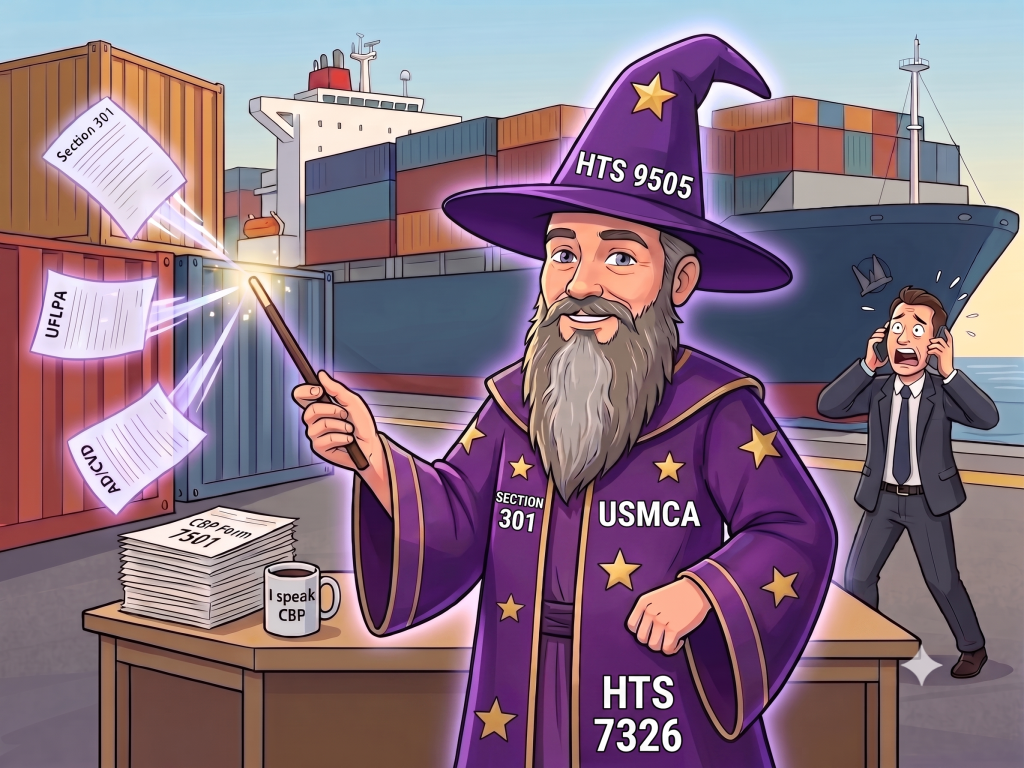
For 25 Years, People Thought I Smuggled Drugs. Now They Just Think I’m a Wizard.
I have spent a quarter of a century in international trade compliance. Twenty-five years.
For over two decades, trying to explain my job to anyone outside of a customs house has been an exercise in absolute futility.
My own daughters look at me when I talk about my workday like I’m reciting quantum physics in ancient Aramaic. They eventually settled on telling their friends: “Yeah, our dad works in… shipping? He looks at boxes. Sometimes he sighs loudly at a spreadsheet.”
That’s the polite version.
The general public has always had far more colorful theories. Whenever I tell someone at a barbecue that I work in “cross-border trade and regulatory enforcement,” their eyes light up. They lean in, lower their voice, and whisper:
“Oh wow. So… can you get things past the dog teams? Do you know El Chapo?”
No, Brenda. I cannot help you smuggle contraband in the spare tire of a Honda Civic. I deal in Harmonized Tariff Schedule classifications. If you want to legally import 40 tons of unexpectedly complex industrial brackets without triggering a 25% Section 301 punitive tariff, I’m your guy. Narcotics? Way out of my jurisdiction — and frankly, the regular paperwork for CBP is terrifying enough without a prison sentence attached.
Then there were the corporate executives who assumed trade compliance was a glorified rubber-stamp department. They honestly thought my job consisted of wearing green eyeshades and making sure the zip codes on FedEx labels were spelled right.
Welcome to the modern era, everyone.
After 25 years in relative obscurity, something shifted. The global trade landscape started changing faster than a tariff tweet. Section 301 duties swinging like a wrecking ball. Anti-dumping orders multiplying. Forced labor enforcement tightening. Supply chains fracturing before lunch.
And then my phone wouldn’t stop ringing.
The same C-suite executives who used to treat compliance as an annoying afterthought were suddenly sweating through their bespoke suits, calling me at 6:00 AM on a Saturday like I was a late-night crisis hotline.
“James! Our container has been sitting at the port for six days and nobody knows why!”
“James! If we weld the left side of this widget in a different country, does it magically change the country of origin?!”
Suddenly I’m not the boring guy who ruins margin projections anymore.
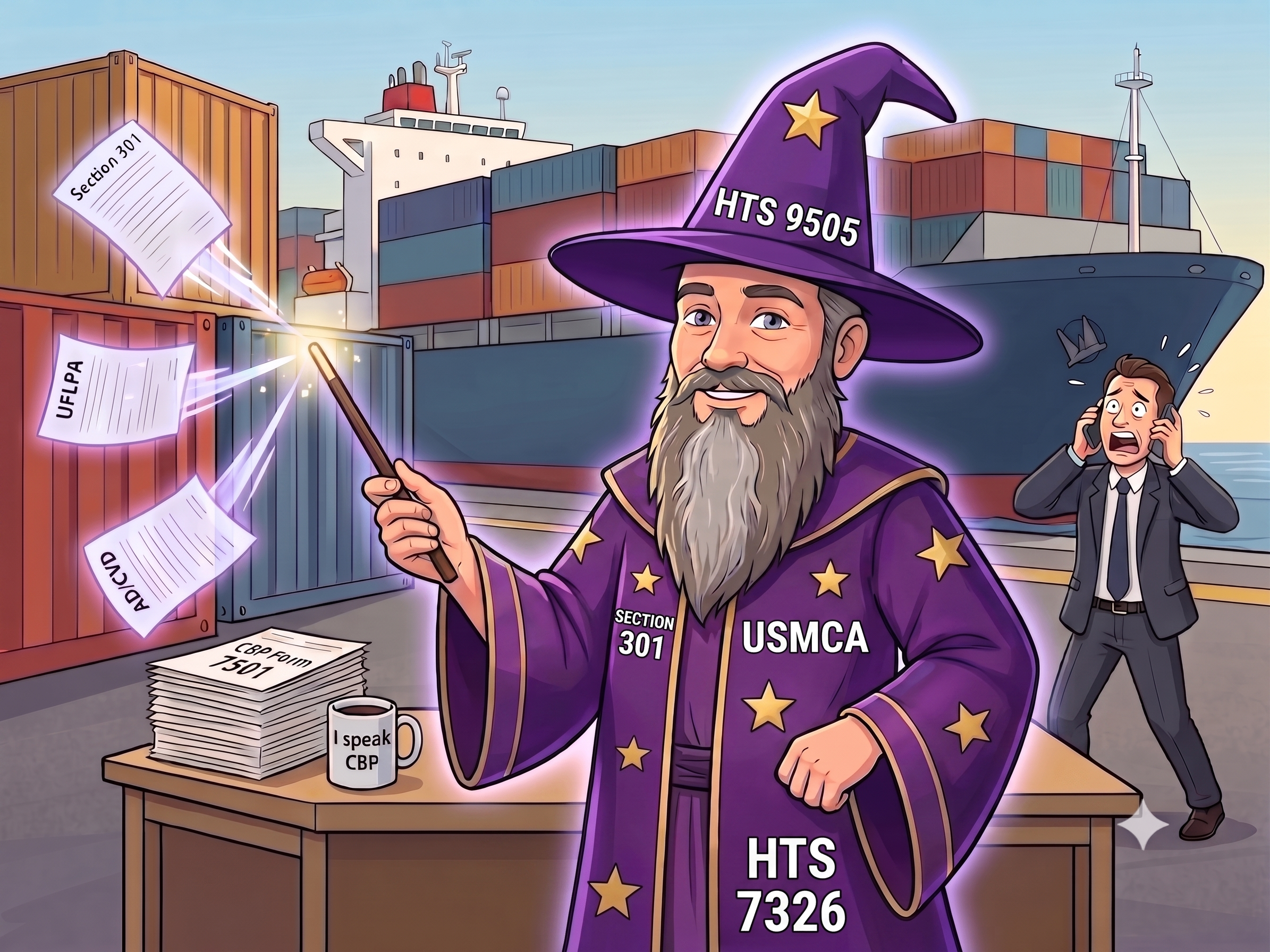
I’m Merlin. A corporate sorcerer casting tariff-engineering spells to save millions of dollars. People are finally realizing that trade compliance isn’t about checking boxes — it’s about navigating a geopolitical minefield with a blindfold on and a smile on your face.
So to my daughters: No, I still can’t get you a discount on imported designer shoes.
To the guy at the gym: No, I still can’t help you bring back three suitcases of unpasteurized cheese from Europe.
But to the global business community currently hyperventilating over the newest trade restrictions?
Yeah. I’ve got this. I’ve been waiting 25 years for the rest of the world to catch up.
Now please excuse me. I have to go explain to a room full of grown adults why their imported product is legally classified as a “festive article” — and why switching a screw from steel to aluminum just saved our entire Q3 budget.
James Ferry is the founder of Ferry Trade Group and has 25 years of trade compliance experience. He writes at Trade Underground and was recently published in the Journal of Commerce.
Working as an entry writer on September 12, 2001, I picked up the phone to hear a panic-stricken IOR, nearly in tears. Begging me to call the FAA to ask for permission to open the airport to allow them to pick up their cargo, to avoid a plant shutdown. No, Brenda. The country was just attacked, we don’t have a batphone connected to the FAA.